Wednesday, February 23, 2011

More About Life in the 1940's

  More about life in the 1940’s

    I will go into a little more depth about what life was like in the 40’s.  In March of 1940 my parents moved from a farm 2 miles south of Hope MN to a farm 5 miles south of Owatonna on the Lemond Road.  This farm was large and had 360 acres.  I was in 8th grade at this time so here we go attending a new school where I didn’t know anyone.

    The school was located 2 and ½ miles from the farm.  One of the neighbors came over and said that they had a car pool going to school and we were welcome to be in the car pool.   Once a week each family drove the children to school.   There were 5 families involved and  7 children.  So 7 children were  in the car and off we went to school.  Remember this was before the days of seat belts and the cars were a lot smaller than they are now.

    I was the new kid on the block and was in 8th grade but I had no trouble getting along in this school.  I think we started at 9 a.m. and got out of school at 4 p.m.  We had an hour for lunch and then had a morning recess of 15 minutes and an afternoon recess of 15 minutes.  The 7th and 8th graders helped the teacher with the first graders and I think there was 6 children in first grade.  Only a couple of them had learned anything about learning to read.  So we helped them with their reading as best we could.  I remember listening to the first graders recite.

    At the end of school  we had a school picnic.  All the neighbors brought food and drinks for a nice mid day meal.  The older children in the neighborhood came to the picnic and some had already graduated from High School in Owatonna.  It was a good way for my folks to get acquainted with the neighbors and suppose my Dad made the connection with neighbors about harvesting oats.

    There was a small creamery about a mile from the house and my brother Larry went to the creamery every third day.  Two other neighbors exchanged days and they hauled the cream in the cars.  Steele county was known as the Butter Capital of the United States at that time and there were small creameries scattered all over the county.
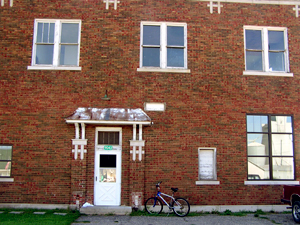
Hope Creamery building


    This new farm had a small woods on it.  Suppose the woods covered about 10 acres.  I was always off exploring and in the summer there were several patches of wild raspberries.  There were also small patches of wild strawberries on the farm and they were very small but good to eat.  There was a huge hip roofed barn on this place and you could drive a team into it on the second floor or hay mow.  We used to go up in the hay mow and jump off the beams into the hay.  One time my brother Dick jumped about 10 feet but he didn’t get hurt.

    I was the only girl at home so I helped my Mother around the house.  By that time I was doing some cleaning by myself and always wiped the dishes after a meal.  We had a nice flat lawn in front of the house and I kept the lawn mowed.  The folks bought us a croquet set and my brother Dick and I played croquet every nice day that we had in summer.  Now remember I mowed that yard with a push mower by hand.

    At this time I was also milking cows.  We had been able to purchase a small milking machine that was run by a Briggs and Stratton motor.  There was no electricity on this farm.  After we washed the cows teats then my brother would put the milking machine on and milk the cows.  We always had to go back in with a pail and do what we called the final stripping to get all the milk.  We put the milk in a bowl on top of the cream separator and then turned a handle by hand to separate the milk from the cream.  There was 2 spouts on the cream separator and the cream came out one and the milk out the other.

    We put the cream in a can after the evening milking and then we put it in a cold water tank to keep it cool until the next morning.  Then we put the morning cream in and took it to the creamery early in the morning.  The separator had to be carefully washed every day.  We had a bench outside the pump house and I washed the separator every day.

We always ran cold water through the separator after we had finished separating the milk and the cream.  That came in handy to know when I had children as I rinsed the bottles out after feeding the babies.

    In the winter time we kept the cows in the barn and would let them out to drink water.  We had a cast iron stove of some kind or another and we had to light a fire in it to melt the ice on the water tank.  My Dad took the skim milk down to the hog house and he mixed it up with grain for the hogs.  We called that stuff slop.  In other words we slopped the pigs. We didn’t have an ice box until the summer time.  My Mother would make home made ice cream in the winter as we would get the ice out of the cattle watering tank.  She used pure cream and made a custard for the ice cream base.  Boy was it good.

    In the fall of 1940 I moved down to east of Ellendale  with my sister Dorothy and family.  This was so I could start High School at Ellendale. My nephew Warren was about 4 years old at that time.  I helped Dorothy the same as at home.  She was a terrible hard worker and she was out milking cows every morning and evening.  I didn’t do any milking there but I watched Warren and I picked up eggs and was just generally useful as a 13 year old can be.

    My clothes for High School weren’t to classy but then no one else had anything that looked much better.  I remember that Dorothy made me a nice wool skirt out of some things that Uncle Ernie had sent to us.  I caught the bus into High school and they had two routes to cover.  I was on the late route going to school and then I was on the late route coming home.  In the winter we had about 45 minutes after school and so the boys and girls would play basketball .  We would get up a team from various classes and I played forward.  Got half way good at shooting baskets.  We usually got on our bus to go home about 4:30.   Wouldn’t the teachers today have a fit if they had to watch a bunch of kids after school for 45 minutes.  But we probably acted better.  I also read and did home work in that period of time.

    I remember the terrible blizzard that we had on Nov 11 1940.  I went to school that day and it was a real warm day for November.  About 11 a.m. it started to snow.  I remember our High school Supt looking out the window at the snow.  The Supt’s office was right across the hall from our home room.  A little while later he called for the early morning bus riders to get ready to go home.  He had called the bus drivers early and decided it was best that we get home.  I of course went home on what we called the 2nd bus.  By 2p.m. we had a raging blizzard on our hands.  My sister Dorothy told me that we had to go out and round up the chickens and get them in the chicken house.  The chickens had been out all morning scratching around for seeds and bugs and whatever.  The blizzard lasted for about 3 days and a lot of people died.  They got caught out away from home in their cars and couldn’t get to shelter.

    My brother Don was a Senior in High School while I was in 9th grade.  He worked on a farm that year and rode the bus to school.  Don played football, basketball and he was a baseball pitcher.  I think he pitched a no hit no run game in High School one time.  They wanted him to play on the Legion team but World war 2 started and he was off to the Navy.

    While I was in school in Ellendale I sold candy at noon to the other students.  Most of the kids didn’t want to sell candy, they wanted to walk up and down the halls and flirt with the boys.  If you sold candy at noon you were able to eat one candy bar without paying for it.  I sampled every kind of candy that we sold.  We had to make change and turn it in and all that good stuff.

    We had the starting of a hot lunch program in our school at that time.  I think it cost 5 cents.  A woman came in and made stuff for us to eat with our lunch packed from home.  Sometimes we had macaroni and cheese and sometimes hot soup and sometimes hot chocolate.  At Ellendale we all took our lunches to school in a lunch bucket.  The next year when I went to Owatonna all the kids packed their lunches in a paper sack.  A lunch bucket was a no no in Owatonna.

    In the winter time when I was staying with Dorothy I used to go up the road and Eugene and I would go ice skating on a frozen pond close to his house.  Would just do that on Saturdays.  I think we probably played some games with Eugene’s step mother.

    I remember some of  kids problems that were on my school bus.  One of the neighbor girl’s Mother had died and she was in 10th grade.  I think she was going to school and doing most of the housework and helping take care of her younger sister who was in 7th grade.  Another family on the route had lost both parents and there was 5 or 6 children in the family.  The oldest boy was about 22 and he had a sister about 20 and he did the farming with the help of some uncles and managed to put the rest of the kids through school.  Some of the younger children were just in second or third grade.  I think that maybe some of the other farmers in the area helped out with the farm work and advise.  But they kept the children together and they turned out all right.

    People were more inclined to help their neighbors back in that time.  Farmers exchanged work back and forth so that they could get harvesting done and also haying and other chores.  But you didn’t take advantage of your neighbors and try to get by without returning favors.

    I enjoyed the library that we had in the school at Ellendale and was always checking books out to read and take home.  Dorothy liked to read so we would both read the same books.  I probably left the books home and she read them in the day time in winter when there was not much you could be doing outside.  At that time there was no electricity in the house and your heat came from a wood cook stove and then another heating stove in the living room.  There was a wood pile outside and someone had to bring the wood in and think it was stored in a small entryway.   I don’t remember if we used much coal or not.  It came in real handy when I went to work for the railroad to know how to start a fire in a pot bellied stove and how to bank a stove in those cold railroad stations so that all you had to do was add more coal in the morning.

    Dorothy had a big garden and when I was first there in September she had an ever bearing strawberry patch.  I remember her going down and picking a dish pan full of strawberries.  She made shortcake and of course we poured pure cream over all of it.  We did eat good on the farm.  Dorothy was an exceptionally good cook and I enjoyed that. 

    Most of the farming families where I grew up got by in the depression quite well.  We didn’t have anything to spend on stuff we didn’t need but we were always able to have good shoes and clothes to wear and we never went hungry.  Things begin to get better about 1938 and then after the War started there was more money available to buy things.

    I went to Owatonna the next year and stayed at home and car pooled with 2 other neighbors.  My brother Larry said that all he did was car pool at that time.  He went to Owatonna twice a day every 3 days.  Then Dick was in grade school and he had 2 trips to grade school once every 5 days.  Then he went to the creamery every 3rd day.  He said he spent a lot of time in the car getting all the running done.

    When we lived on the farm south of Owatonna a terrible fire happened to one of our neighbors about a mile south of us.  Their 5 year old little boy went out in the barn with some matches and started a fire.  The barn burned down and the little boy was in it.  It was a terrible windy day and pieces of the barn came into our pasture which was about ¾ of a mile north of the barn .  My parents never left any of us alone in the house if they had to go out at night.  We used kerosene lamps and they just didn’t trust us to be careful around those lamps.  We had a healthy respect for fire.  We used kerosene lamps when we were milking in the evening and we were so careful with them.  To this day I do not want a lighted candle in my house.

    My  tenth grade in school was the last year that I stayed at home all year.  The neighbors that we car pooled with graduated from High School and so I worked for my room and board and stayed with the Supt of our High School in my 11th and 12th grade.  A lot of girls that lived on the farm did that and the Dean of Women in our High School kept a list of people that wanted a girl to stay and help them and she  picked out the girls who she thought would make a good fit with  some one on the list.

    I answered the phone and helped with the house work and watched after the two little boys when they had to go at night.  I could go out if they weren’t going anywhere and I had to be in at ten on school nights and at twelve on Friday and Saturday nights.  I sold them about 3 dozen eggs when I would go home every other week and used that money to go to the movies.  The movies were fifteen cents and that was for the shoot em up westerns.  The better movies were twenty five cents.  There were three or four movie theatres in Owatonna.  At that time the population of Owatonna was 5000 people.

    I did go to the football and basketball games at that time.  I also went roller skating and did some ice skating in the winter time.  Mrs Burt sold me her ice skates for two dollars and the city in Owatonna had a ice rink on the Straight river.  They had an attendant at the rink that kept a bonfire going so that we could warm up when we got too cold.  It was high school age kids that went skating and think it stayed open until about 9 p.m.

    This is just a little bit more detail about my life in the forties for a couple of years.

Monday, February 7, 2011

Stories my parents told me.

    I was fortunate  in that I would go see my parents in Minnesota and would usually stay with them at least a week and we did a lot of visiting in that period of time.  I have been working with genealogy for the past 30 years and have found  out a lot more information on my own.

    I will start with my Mother’s family as I know very little about them.  Her father’s name before coming to America from Denmark was Mads Goldfelt.  We think he was Jewish.  He came from the part of Denmark which was next to Germany  and I suppose he was looking for a better life in the States.  My Mother’s mother came from Copenhagen and her name was Anna Thompson.  They  were married and came to the States in about 1865. 

    My grandfather changed his name to Chris Madison when he came to America.  He had been trained as a barrel maker and they came to Linn County Iowa.  He was one of the first employees at the Wilson-Sinclair packing house and was employed as a barrel maker.

Wilson-Sinclair was later changed to the Wilson Packing Co.  My Mother told me that everyone in Denmark was trained to do some kind of work.  Isn’t that amazing that people in Europe were trained for a job and we still do not  do that here in America.

English: Cooper's workshop, Open air museum Roscheider Hof, Konz, Germany
Deutsch: Holz- und Waldmuseum, Küferwerkstatt, Freilichtmuseum Roscheider Hof, Konz


    There were 6 children born in this marriage.  George, Carl ,Ernest, Tillie , a girl who died at 6 years of age and my mother Irene.  My grandfather worked at the packing house and he also did some fishing in the Mississippi River.  They lived in  Marion Iowa.  My grandfather was crippled as a result of an accident.  He was out cutting wood and his axe hit his leg somewhere.  It was a terrible wound and he started a fire and think he cut off his leg and he put the leg in the fire to keep from bleeding to death. 

    My grandmother died when she was 57 years old as a result of an operation to take out her gall bladder.  I did not know  my Uncle’s George and Carl as they moved to Washington state years before I was born.  I did know my Uncle Ernest.  He was a depot agent for the CNW Railroad at Fox Lake Minn and lived about 100 miles from us.  We went down one time and stayed about a week.  I was about 9 years old at that time.  Uncle Ernie raised his 3 children by himself as his wife had died a few years before. 

    Uncle Ernie never got upset about anything.  I could play with the typewriter in the office and helped him carry the mail up to the post office.  They had a turntable at Fox Lake and I could go out and play on it and think he let me fool around climbing on the baggage wagons.  Of course he knew there were not any trains coming while I was doing all that messing around.

    Uncle Ernie had a grape arbor and I remember the grapes were ripe and I think I got sick eating all those grapes.  He used to send my Mother clothing so that she could remake things for our family.   My Mother and Ernie were real close and my two older sister’s used to go see him.  I know my sister Daisy caught the train at Albert Lea and went out to Fox Lake at least one time.

    My Mother graduated from Marion High School in 1907 and she worked as a school teacher for 4 or 5 years.  She met my Father when she was teaching at rural School No 9 and was staying with my Great Uncle Jim Hagerman.  She taught my cousin Everett Cress when he was about in first grade.  Everett and Erma were visiting my folks in Sandstone Minn one time when I was there and they were talking about the old days.  Seems that dist No 9 had ran off several teachers.  My Mother had been teaching for a while when she came out there and the first day a 17 year old boy sassed her and she proceeded to grab him by the shoulders and sit him down in his seat and said “There will be no more of that.“  She didn’t have any trouble after that.

    Everett told another story about a teacher.  He said this woman was small and some child gave her fits and she took the broom and smacked him a few times.  She then got up in front of the class and said ”Now if anyone else wants to sass me, just come on up”  Everett said there was no more trouble in that school.

    Mother met my father while she was teaching at No 9 as I think my father was working for his Uncle Jim.  They were married in 1912 and my Mother didn’t know how to cook.  My folks laughed and told the story about how my Mother made biscuits and they were hard and my Dad couldn’t eat them.  He said ”Irene I think I better go down to Toddville and get my Mother to teach  you how to do some cooking.”  So his Mother came out and stayed a week and my Mother’s biscuits were the best.

    My folks also talked about how my Dad’s grandmother Angelina Hagerman came out and spent a week or so visiting with them after they were married.  She always waited about a month after any of her grandchildren were married and then she would come out a visit for a week.  I remember my father telling me about that when he was past 80 years old  and he said” Oh, how I would like to have those days back.”

      My  folks were married in 1912 and they farmed in the Marion Iowa area for about 5 years.  They then bought a farm about 5 miles north of Albert Lea Minn and farmed there for a few years.  Dorothy was born in Iowa and Daisy was born in Minnesota.  They moved their household equipment and their livestock from Marion to Albert Lea in a immigrant car.  That is you went down to the railroad and arranged to get a car to put all your stuff in it.    You loaded your stuff and then the railroad took you to your destination.  Remember there were not any trucks or roads to move you around in 1917.  Most of your traveling was by train and there were passenger trains everywhere.  My dad went ahead and got settled and then my Mother came later with Dorothy.

    When they moved to Albert Lea my Dad had to take cream to the creamery and there were a lot of Norwegian farmers in that area.  My Dad went home and told my Mother that they were making fun of him and he didn’t like it.  So the next time he went to the creamery he took my Mother and she could speak all the Scandinavian languages and she told the Norwegians  something and they didn’t bother my father again.

    My folks later moved to 3 miles west of Geneva Minn and I have told you some other stories about my life on the farm at Geneva.  We did have a nice orchard and a huge garden on the farm at Geneva.  It was just an 80 acre farm and that is about all one farmer could take care of using horses and no mechanical equipment to do the farming.

    Now I will tell you about my fathers family and it is a long story as his family had been in the states as early as 1630.  My great great grandmother was a Howe and her family goes back to the early families in New England.  She was related to the Hibberd’s and the Walden’s and the Gardiner’s and the Fuller’s.  My great grandmother Angelina Gray Hagerman claimed to be related to the early White family and also to Lady Jane Gray in England. 

    The Gray family showed up in Sharon Conn early on and then they went to Oswego New York and  then they bought land in Tioga County Pa about 1798.  I have a post card that my great grandmother wrote to my grandmother  Sarah Hagerman Cress that says she was born in Gray Valley Sullivan Twp Tioga County  Pa in 1825.  Now you need to remember that my Father knew his grandmother very well.  He was born in 1882 and my great grandmother died in 1914.  Now I will tell you about that families trip westward.

    Hosea Wilson Gray was in Iowa about 1838.  He was a young man and I assume he rode horseback from probably Bradford Pa to Linn County Iowa.  I have no idea who else came west with him.  My research shows that he went back to Pa and told the family about the good land to be had and so several of the Gray families got together and formed a wagon train to move west.  Included in the wagon train was  George White Gray and his family and Silas Gray his brother and his family.  Silas Gray had several sons that were probably in their late teens or early twenties.  George White Gray brought 4 children west with him.  They were Angelina Gray,, Parthenia White Gray, Calista Gray and William Wallace Gray.

    I have the obituary of William Wallace Gray in Sarah Hagerman Cress Sparks bible.  It tells of the trip west and the difficulties that they encountered.  I think they stayed in Ohio for a year and then came on to Linn county.  At that time they must have crossed the Mississippi river on some kind of a ferry.  Now here comes the interesting part.  Amariah Hagerman came west with the wagon train.  He was about 21 years old at that time.  He did not have a wagon and probably rode horseback all the way.  He was very important to the wagon train as he was a trained wheel wright.  That  is he knew how to fix the wheels on the wagons.

    Angelina Gray was a comely 15 years old at that time and Ameriah probably took a shine to her as they were married in 1845.  Ameriah came from near Williamsport Pa and his father James and grandfather  Aaron came into that area soon after the Revolutionary War.  There is a creek or small river in the Williamsport area named Hagerman’s Run.

    My father, Rob Hagerman and Mary Beggs made a trip by train to Williamsport Pa in 1907 and I have a picture of them in my possession at their great grandfathers grave at Newbury Jct Pa.  This is close to  Williamsport.  Dale and I tried to find the grave and we found the church and some older people said there used to be a grave yard near where the church was located but that the headstones had  been taken down  several years before.  That was about 25 years ago. 

    My Father used to get letters from one of his cousins Anna Hagerman  into the 30’s.  I have my fathers letters that were saved and some go back over 100 years.  Dale and I went into an antique shop in Williamsport and were asking around about the Hagerman’s and an elderly lady in the shop knew about Anna Hagerman.  She said she had been a school teacher.

    While in Williamsport we went to the library and did some research.  They have a wonderful genealogy section in the library at Williamsport.  At that time I didn’t know much about the Gray’s except what my Dad had told me.  So I found a history book in the library and it was the history of Tioga County which is the next county north of Williamsport.  Lo and Behold  the Gray’s were in the book.  Now my dad’s name was Lafayette Gray Cress and I have a picture of Lafayette Gray who my father was named after.  Well here Lafayette Gray shows up in that book along with some other Gray’s.  I copied that stuff off and then Dale and I decided to go to the county seat of Tioga Pa which is Wellsboro Pa.

    We went in the library and they had 40 pages of information about the Gray’s including the info about the Gray family burial ground.  We photocopied off that information and then head out in the country south of Mainesburg Pa trying to find the family plot.  We had a map  where it was located and stopped at a farm near by and asked about it and if it would be all right to go check it out.  The young man at the farm didn’t know about the burial ground but he knew where to take  us.  We walked across a field of tall grass and found it.

    Parthenia White Gray and James Gray were there as was Angelina Gray Hagerman’s mother Sarah Howe.  There was a flag at James  grave indicating that he was a Revolutionary War veteran.   We also read Sarah’s stone and it read Howe.  So my grandmother Sarah Hagerman Cress was named after her grandmother.  Sarah Howe died in 1834 before the family came west.

    My Father was named after Lafayette Gray and I think he was probably a favorite cousin of my great grandmother’s.  I do have a picture of him and his wife in my collection of things.

    The family came west about 1840 or 41 and I think George White Gray settled in the Marion area.  You could homestead at that point in time and the land probably didn’t cost anything except the filing fees.  Ameriah Hagerman and Angelina Gray were married in 1845 and they settled in Otter Tail Twp close to Toddville Iowa.  They had 10 children and raised 5 of them to maturity.  Angelina lost 3 little girls before my grandmother Sarah was born in 1850.

    The whole family lived close to each other after they were grown.  Jim Hagerman, Robert Hagerman, George Hagerman, Billy Beggs who was my Aunt Ellen’s husband and Jacob Cress who was my grandmother’s husband all lived close to each other.  My grandfather Jacob Cress died in 1895 when my father was 13 years old and his brother John was 15.  The boys had to do the farm work and my  Father talked about hoeing corn by hand.

    I will now tell you a few stories about life on that farm.  My grandmother was a very religious woman and they all walked down the railroad tracks to church on Wednesday night and then they walked to church twice on Sunday.  This was after my grandfather died and I suppose my grandmother was lonely and  farm work was hard.  I think her brothers helped with the farm work as they were living close to each other.

    My Aunt Mina, my dad’s sister told me about the children swimming in the Cedar river and my dad told me about catching catfish in the Cedar River.  My aunt Mina said all the kids were down at the river one time and the boys had gone in swimming and left all their clothes on the bank.  The girls came down and took their clothes and she said Uncle John just stayed in the water but my Dad came out naked and got his clothes.  Aunt Mina was probably about 80 at that time and we laughed and laughed about that.  Her granddaughter Ann told me just about a year ago that  Mina never talked about any of her sister’s and brother except my Dad.

    My Dad brought a deck of cards home once and his Mother took them and burned them in the cook stove.  When my Dad was past 80 he would say ”My Mother would turn over in her grave if she knew I was playing cards.”  He loved pinochle and 500 and think he used to play gin rummy at the tavern in Hope for money.  When Dale and I would go to Minnesota we wouldn’t be in the house 10 minutes before my Dad was getting the card table set up.

    My grandmother remarried in 1905 and the boys were grown so they were out on their own.  John married at 18 but my Father married when he was 30.  He left Toddville for a while and went to Duncan Ariz with someone who was going to farm in that area.  He said they left El Paso Texas on the train coming back to Iowa and it took all day for the train to go from El Paso to Ft Worth.  It’s about 550 miles.

    Now I need to tell you about his other grandparents who also came to Iowa about 1840.  His grandmother Lydia Neighbor died in 1864 and her family had been in the States since 1738.  Her Mother Margaret Weise Neighbor came west out of Newcomerstown  Ohio in about 1840.  Margret had 8 children with her when she came to Iowa.  The Neighbors or Nachbar’s had settled in and around Dover New Jersey in 1738.  They came west in 1815 along with several other families and settled in what was later called Newcomerstown Ohio.   I know quite a lot about the Neighbors that I have found out on my own as not to many stories were passed down to my Father.  They did come by wagon train and I think they spent a year in Ohio and then came on west and settled in the same area that the Hagerman’s settled.  The Neighbors and the Oliphants were good friends and my Great grandfather John Cress and Lydia Neighbor and my Grandmother Sarah Hagerman Cress and Jacob Cress are all buried in the Oliphant Cemetery near Center Point Iowa.

    They were farmers and teachers and preachers and were in every kind of business close to Center Point Iowa.  My Dad said at one time that he was related to almost every one in Center Point Iowa.

    Lydia Neighbor and John Cress had 6 children and I have family information on all of them.  Lydia died in 1864 and suppose it was child birth fever.  I do know that her sister Mrs Thomas and her husband raised 5 nieces and nephews including my Great Aunt Mary Cress who later married a Mounce.  About 20 years ago  two of Mary’s daughters were still alive and living in Center Point and I visited with them a couple of times.  The oldest Maude Price could remember my grandfather Jake Cress as she was 97 years old at that time and had been about 10 years old when my grandfather  died.

    John Cress my father’s grandfather came west about 1841 or so with several brothers.  He had came out of the Richmond Virginia area and they were probably looking for land to homestead out west.  He and Lydia were married in 1845 and he lived until 1888.  My Dad said he was always afraid of him as I guess he had red hair and he was just a small child at that time.  They had changed their name from Grass to Cress and they were also of German stock and I have information on that family all the way back to Germany into the 1600’s.  It was a tradition in that family that the Fathers name would be John and that his oldest son would be Jacob and then Jacobs oldest son would be named John.

    Many of the daughters were named after their grandmother’s.  Sarah Hagerman was named after her grandmother Sarah Howe Gray.  My Aunt Angie was the first born child of Sarah and Jacob Cress and her given name was Angelina Lydia Cress.  She was named after both grandmothers.  You will find that a lot when checking through the old records.

    I remember one more story that my Dad told and that was when he was working for someone as a hired hand and his employer got into a squabble with a neighbor about a cow.  They had to go to court and spent a lot of money getting this settled.  My Dad always said to stay out of troubles with the neighbors and save your money for something else.

    My Father also told about the time he went to Cedar Rapids for something and decided that he would do a little drinking.  He went down and bough a bottle of Peach Brandy and got a little tight on it.  He said he got up the next morning and took a drink of water and he got tight again.  He said that cured him from drinking.  He never smoked or drank and lived to the ripe old age of 95.  This is a few of the stories that I remember.

Sunday, January 9, 2011

Trips on the trains throughout my life.

Trips on the Trains

When I was growing up the best way to get around was by trains.  The interstate Highway system had not yet evolved and you could go everywhere on the trains for a small cost.  The first trip that I remember was on the RI railroad out of Minneapolis to Owatonna Minn.  My friend Myrtle were living and working in Minneapolis and we want to go to Owatonna for one day of the county fair.  We went down to the Union station in Minneapolis and purchased our ticket to Owatonna.  We were really country bumpkins and we sat in the station and missed our train.  We went to the ticket counter and they told us we could catch another train to St Paul and then catch our train to Owatonna.  We got into St Paul and had to run to catch the other train to get to Owatonna.  This was in 1944 and the train was filled with  young men from around Waterloo Iowa who were joining the army.  Myrtle met the love of her life on that short trip from St Paul to Owatonna.   In a  couple of weeks Herman showed up in Minneapolis to see Myrtle and she married him after the war.


My next trip on a train was when I was hired by the Santa Fe Railroad and  17 of us from the Radio School were hired by the Santa Fe as telegraph apprentices and we went to Chicago to the Santa Fe Headquarters and were assigned different states  as our final destination.

We stayed in Chicago one day and I had picked Oklahoma as the state  where I wanted to work.  We all left out of Chicago on Santa Fe No 5 from the old Dearborn Station.  The train was crowded and the seats were horrible.  The Santa Fe and other railroads had to get out all their rolling equipment to take care of their increase in traffic on account of the war.  We were able to get a seat and didn’t have to stand up. But it was uncomfortable, the train was crowded with servicemen and young mothers with their crying small children and the mammas were cranky and fussy.  We finally arrived at Arkansas City Ks after 18 hours on the train.  We ate the dry sandwiches that the porters brought through the train. Think it was mostly  lunch meat and cheese, not much choice.

We arrived in Arkansas City and stayed overnight and then started out the next morning on Santa Fe No 27  to get to our destination.  We came through Ponca City Okla about daylight and the train went right through the Continental Oil refinery.  That was a interesting sight.  I and my friend Betty Soper arrived in Guthrie and we had to wait their for the doodlebug that ran from Guthrie to Kiowa Ks.  If I remember correct it was No 54.   Betty detrained at Crescent Okla as that was where she would take her training.  I went on to Cherokee Okla as that was the town I had picked out to train  for my job as a telegraph operator.  The train was a small gas powered train that had one car.  In the front of the car was the mail section and just behind that was the Railway Express section and behind that was the passenger section.  At that point in time mail was transported from one part of the country to another by train.  They also sorted the mail and you could mail letters at the train station and it would be sorted on the train.

I went through Crescent, Marshall, Douglas, Enid, Hillsdale, Nash and Jet before arriving in Cherokee in the afternoon.  The train went through the south edge of the Salt Plains and I thought I was going to be living out in the desert.

The next train trip I took was probably going up to Wichita Ks and back on the same day.  This was also a doodlebug that came out of San Angelo Texas and went into Wichita.  This was the old Orient line that the Santa Fe had bought out.   The train numbers were 45 and 46.  This train came into Cherokee early in the morning loaded with railway express for small business people in Cherokee.  They were often down at the depot to meet the train as they had ordered parts and stuff that they needed to get to their customers.  I helped write up the express bills and give them to the delivery man.  The railroad at that time in 1944 was handling a lot of the small package business as we did not yet have our interstate highway system.

When I moved from  Cherokee to Newkirk I had to go into Wichita and then catch a train south out of Wichita to Cherokee.  The railroad gave us a pass to get from one destination to another.  We did not get a pass on the streamliners just on the other trains.

I rode trains getting from one place to another while I was working the extra board relieving operators and agents for a couple of years.  When I was able to bid in the swing job between Newkirk and Ponca City I lived in Newkirk and rode the train back and forth all the time.

When we had vacations we were able to get passes on other railroad, so when I went to Minnesota I would get a pass on the Rock Island out of Kansas City to Owatonna…After World War 2 ended the trains
 were no longer crowded and it was nice to ride the trains again.  I went home to Minnesota in Aug of 1946 to spend a few days.  Caught the Rock Island out of Kans City to Owatonna.  I stayed about a week and then started back to Oklahoma.  We had a cold front come through Minnesota and was wearing a wool suit and it was comfortable.  Didn’t wear it on the train and when I got into Kansas City on the way back it was 11 p m and the temperature was 105 degrees.  I knew I was back in the south.

I made another trip home before I was married and this was probably in February of 1946.  The younger operators on the extra board had to take their vacations in the off months so that was why I was vacationing in February.  On that trip I decided to take my brother Richard on the train to Minneapolis in the morning and come back in the afternoon.  He had not been on a train before and was about 13 years old at that time.  We went into Minneapolis and went shopping downtown.  The station was only about 6 blocks from the downtown area at that time.  Decided to eat a meal on the way back to Owatonna and that was a special treat for Dick.  All the larger passenger trains had a dining car and the food was  very good.  The silverware was very nice and the plates and cups and saucers were real heavy duty  so that they would stay on the tables and not shift around.  The tables had cloth tablecloths and cloth napkins and you really ate in style.

In 1947 after I was assigned to the Newkirk-Ponca swing job I made a trip to Amarillo Texas with my friend Helen Alford.  We were both able to get passes  and so we went to Amarillo.  We left Newkirk and changed at Wichita and caught 23 out of Wichita to Amarillo.  We went out there about a week after a deadly tornado had started up the Santa Fe tracks  near Pampa Texas and kept on going all the way to Waynoka Okla and then some.  Everything looked like it was damaged at Waynoka and I think over 200 people were killed and some  were found that were never identified.  It also hit Shattuck and other small towns along the railroad.  At that time no 23 was not air conditioned and this was the last part of May.  The windows were opened on the train and the dirt blew in and that was something else.

We stayed with Helen’s fried for about 3 days and drove around Amarillo.  At that time in late May the Paul Scarlet roses were blooming in Amarillo and it seemed like every house had some beautiful rose bushes.  We made a day trip down to Canyon Texas and went down into the Palo Duro Canyon.  You  are just driving along and here comes the canyon.  I have never been back and I understand it is quite developed for campers and such now.  This is where the Native American people holed up in the winter time.  We came back to Newkirk after staying in Amarillo for about 5 days.

When I worked in Edmond in the fall of 46 I used to catch the interurban trolley down to Okla City a couple of times a week.  At that time the interurban ran from Guthrie to Okla City and then there were other connections down to Norman and then west to El Reno.  I don’t remember when the interurban was abolished but think it was in the late 40’s or early 50’s.  People were not able to purchase new cars until about 1947 and I think you had to be on a waiting list to get one.

When I lived in Minneapolis in 1944 the only way to get around was on the street cars.  There seemed to be one going every 5 or 10 mins  on the lines that were close to where you lived.  That same thing exists  today in Lima Peru but it is busses and vans and taxies that you see there.  You can stand on a street corner in Barranco Peru for 10 mins and see 50 busses, vans and taxies go by.

The next train trip that I made and remember very vividly was the trip to Minnesota that I made in  Dec of 1950.  My parents had not seen our son Hugh and so I decided to go to Minnesota the first part of December in 1950 as I had a two week vacation.  So off I go ,went to Kansas City on the Santa Fe and then took the Rock Island to Owatonna Minn where my brother in law met me and took me to their house for a couple of days.  I visited with my sisters and then made a trip to my folks who lived at Willow River Minnesota at that time.  The train was late into St Paul and I missed the connecting train to Willow River.  It was storming at that time and I had to telegraph my Dad at Willow River and tell him that I was coming on the bus.  He was sitting in the depot at Willow River so the agent was able to tell him I would be on the bus.  Dad and Richard met me and we drove out to the farm.  A blizzard came in and we were stuck out there for 5 days.  Hugh had a cold and my Mother fixed up her onion cough syrup and it cured his cold.

We started back to Oklahoma when the weather cleared and the trip was uneventfull until we got to Kansas City.  The Rock Island train was late for my connection, but I knew that No 23 should still be sitting in the yard with a Pullman car that switched out at Newton Kansas and came through Ponca City.  So off I go and get some milk for Hugh and I found a porter to carry my suitcase and I had Hugh.  I ran down the tracks and got on the Pullman car.  The cost for a lower berth at that time was $3.50.  So I paid the porter and we got in the berth, undressed and went to sleep.  The porter would come by and wake you up at about Winfield so you would be ready to get off the train.  A man in the upper berth also got off at Ponca City and I remember him saying that my baby slept  well after getting on the train at Kansas City.  Can you imagine traveling that way now?

I would go back in forth to Minnesota a couple of more times on the train while Hugh was small.  Dale and I never got our vacations at the same time so I would go see my family once a year.  Hugh and I and Gail went to Minnesota when Gail was 10 months old.  I think that time we went over to Caldwell Kansas and went direct to Owatonna without changing.  Dale could get us passes on the Rock Island at that time as I had resigned from my job on the Santa Fe.

The last time we went to Minnesota was in 1966.  At that time the railroads had lost the contract to haul mail for the post office and they were beginning to cut out passenger service in the states.  We caught the train at Caldwell and I left my car over there for a week or so while we were gone.  The trip was  interesting and it got a little more interesting after we left Des Moines Iowa on the way back.  Gail and I were in the coach car and Hugh went back into the lounge car for a while.  You could buy drinks and candy  in the lounge car and the seats were a little more comfortable.   Well several women got on at Des Moines and they were going to Kansas City for some kind of a convention.  Seems they got to drinking and telling jokes and Hugh was having a great time listening to them.  He was 16 at the time and said those women  were so funny.


That pretty well ends my trips back and forth to Minnesota.  I will now tell you about trains in foreign countries after 1970.  We went to Peru in 1972 and drove from Huancayo to Cusco and then we took a train from Cusco to Machu Pichu.  We got on the small train in Cusco and went through several small villages on the way to Machu Pichu.  At each small village people would come on the train selling everything imaginable, but mostly something to eat and some crafts.  The people were dressed in their colorful clothing and most were barefooted.  You were considered wealthy if you owned a good looking pony.  I can still see a man about 40 years old on his white pony at one of the small stations.  He was really King of the Road.  The train stayed at Machu Pichu and we went down and back in one day.

In 1980 I went to Peru with Betty and stayed in Huancayo with her family for a couple of weeks.  We decided to go from Huancay to Huancavlico one day on the train.  It was a couple of hours trip on a train similar to the doodlebugs that we used to ride in the states.  We arrived in Huancavlica and I had felt a little under the weather on account of the altitude of 14000 feet.  So off we march to the Tourist Hotel to get a cup of  coco tea.  After drinking that I was all right and we walked around town looking to buy some leather goods which Huancavlica is famous .  We couldn’t get seats on the train back so we had to go to the bus station and buy tickets.  Well we got our bus tickets and reserved seats and got on the bus.  The bus travels one block and then fills up with people standing  all the way to the back of the bus.  It was really crowded and I remember one incident after all these years.  A man got on and he was a little bit or a whole lot drunk and he took the liberty of trying to fondle some of the women.  He got a hold of someone about 30 years old and she slapped the heck out of him and he then sat down and went to sleep.  Nothing like traveling to get an education…Wow

The next train trip was in the United States on a narrow gauge railroad.  We had taken a bus load of boy scouts from Enid out to Cimmaron New Mexico and left them there for 10 days.  We had also taken one of our vans and so we decided to stay in New Mexico and look around for 10 days.  We went to Taos and Santa Fe and then decided to go to Farmington across the northern part of New Mexico.  We stopped at the small city of Chama and decided to stay overnight and catch the narrow gauge train up to Antonito Colo the next day.  This was in the early 80’s and the area around Chama had not been developed much at that time.  We went up to Antonito on the train and then came back to Chama  the same day.  This was in July or early August and it was snowing a bit at Antonito.  The scenery was very good and it was a neat trip.  We went through Chama in 1997 and it had really built up and lots of tourists go there now.  Glad we went when it was still sort of undeveloped.

In 1985 I went to London with Gail while she was teaching a class for Conoco.  Steve couldn’t go so I was happy to go on the trip.  We decided to go to York from London  while we were there.  I forget what station we departed from but think it was Charing Cross.  In London you all line up in neat lines to get one the train.  No messing around and pushing and all that good stuff.  We went to York and stayed over night, toured the area of york and then came back the next day as Gail was teaching the following Monday.    There are trains going almost every hour to many of the large cities in England and they are very nice trains.  It was interesting to see the countryside and see the old churches and such in York.  We came back and finally got some of the English people to talk to us and had a nice visit on the train.  Of course while in London we rode the trains in the tube.  It’s not called the subway in London, it’s the tube.

In 1993 Dale and I went on a tour to Australia, New Zealand and Fuji.  We were on a couple of train trips during this vacation.  We left Hawaii and arrived in Cains Australia about 9 hours later and were very tired.  We went to the hotel and deposited our luggage and then we went off on a tour of the surrounding area by train.  This was a narrow gauge railroad and the cars were open as the climate is very hot.  We probably went about 10 miles from the main part of the city and we saw some native dances and some native artifacts and then came back to our hotel in the evening to rest.

We then went to Sidney and later to Melbourne and then we flew from Sidney to Christchurch New Zealand.  The plane was late out of Sidney and we arrived in Christchurch about 1 a. m.  We had a room in an old fashioned Victorian hotel but were only able to sleep about 3 hours before getting up the next morning to catch the train.  There was a big old fashioned deep bath tub and I filled it up and soaked for a while as I was very tired.  Got up early the next morning and went to the train station.  This train was used mostly for tourists and it ran from Christchurch  up the mountain and the trip was about 4 hours.  Saw a lot of the New Zealand countryside  and then we detrained and traveled by bus the rest of the time in New Zealand.

The next and last trip that I have made on a train was into the Copper Canyon in Mexico.  I went on a tour in 1999 and for part of  the trip we traveled by bus.  We went to a large city in Mexico and stayed overnight and the next day we started west on the bus.  We went into the part of Mexico that had been settled by Mennonite people in about 1920.  The Mexican government allowed them to settle and have their own schools and own language and with the understanding that they would never have to serve in the military.  The Mennonite people have  very nicely developed farms and orchards  where they live.  Our guide told us that when they know a hail storm is coming that they cover their apple trees with plastic to stop any damage to their fruit.  We had a meal at a Mennonite restaurant and was the typical good German food.  After leaving that part of Mexico we caught the train for our next stop.  We would travel for part of a day and then get off the train, see the local sights and then catch train the next day for a few hours.  We stayed one day down in the canyon at a tourist hotel.  Quite  a place, lights out at 10 p m and they had a water shortage and water had to be hauled in by truck.  From this hotel we took a 2 hour bus ride further down into the canyon.  The native people that live in the canyon come up near the top in the summer time and then in the winter they move back down into the bottom of the canyon as it is warm down there.  The scenery is unbelievable  and it was a trip that I had looked forward to for many years.  Dale and I had always talked about making this trip but he was very ill and died before we were able to go.  This concludes some of my trips made by trains over a period of 60 years.

Friday, December 24, 2010

Late 20's into my 30's

Late 20’s into my 30’s

    I had major  surgery when I was 28 years old.  I had an egg break in my ovary and the pain was horrible.  Dr. Gilbert operated and my recovery was easy.  That same year dale bought a boat and a 25 H P Evinrude motor.  We started to water ski and became fairly good at it.  Eddie rode the surf board and he liked to ride in the boat.  I learned how to drive the boat and pull Dale around the lake.  We used the cabin and water skied until Gail was born.  We went to Grand Lake with bob and Emily record and also to ten killer and the Salt Plains.  We were burned out on skiing after a while.  Too many good time friends liked to come out and use the cabin and us.

    My brother Richard was killed in an auto accident in May of 1957.  Five young men in 2 cars were killed near Willow river Minn.  Such a sad time.  I was grief stricken about that for a longtime.  Dick had been in Okla the year before and stayed with us for about 3 weeks.  We were the two youngest in the family and had a special relationship.  Need I say more.  I still cry when I think about it.  First Don and then Dick.

    Gail was born Oct 13 1959 and I did not go back to work after she was born.  She was a good baby and the apple of her father’s eye.  She had dark red hair and blue eyes and a very fair complexion.  I had to change my whole life around and make new friends and find other things to do.  I did start to sew more for Gail and myself but the quilt making was 10 more years down the line.

    Hugh went to Washington school after Gail was born and continued to do well in school.  Miss Hoffman the principal said to me that they expected him to be a hand full because he was so bright but he was a normal and well mannered child.  He started to play the Cello in 5th grade and then transferred to the double bass in the 7th grade.  He started piano lessons with Mrs. Chisholm.  I bought community concert tickets and exposed him to good music.  We also bought a piano and he took lessons for several years.  His last piano teacher Moe Anderson later became extremely successful in selling real estate and working for Merrill Lynch.

    I started bowling when Gail was about 2 years old and Hugh baby sat for me.  One day I made a lemon pie and put a piece in Dale’s lunch and left the rest on the table.  When I came home from bowling the whole pie was eaten.  So at 8:30 at night I just made another lemon pie.  Guess Gail and Hugh were full.

    When Gail was 5 and Hugh was 15 he would still baby sit for me.  He told her that if she didn’t bother him he would let her sit on the bed and listen to Beatle record while he studied.  When Gail started school she knew all the Beatle records.  Hugh rode his bike to Junior High part of the time.  He was in SMSG algebra in 9th grade and did very well in school.  Think he was in the 99th percentile on the Iowa test in Junior High…
  

Thursday, December 23, 2010

Danny comes to Ponca City

Danny comes to Ponca City

Our son Hugh had enlisted in the Peace corps in 1969, he then went to Brockport NY for his training and was sent to Peru in 1970.  He married a Peruvian girl named Betty Manrique Galvez and two children were born in this marriage.  Carolina in 1972 and Daniel in 1974.

Betty and the children came to the States in 1979 and stayed 4 months in our house until they could speak and understand English.  Hugh was in Saudi Arabia at this time working for Collins Radio and setting up the telephone system out in the desert.  Betty and the children then moved out of our house to a house of their own at 408 E Emporia.  Betty and Hugh divorced and Betty and the children returned to Peru in 1981.  Dale and I maintained a good relationship with Betty’s family.

My husband Dale and I traveled to Peru about 7 times between 1972 and 1989.  In 1989 the Shining Path Guerillas were very active in the countryside and smaller cities.  Their favorite tactic was to blow up the high line towers in the mountains and you never knew if you would have electricity or not.  The regular police also stopped you on the roads and examined everything in your car and purse using a sub machine gun to keep you from protesting.

Betty had called Hugh in the fall of 1989 and asked if he would like to have  Danny come to the States and live with Hugh and Sunday.  Carol was finishing High School so I and a friend went to Peru Dec 12th 1989 to see Carol graduate and to bring Danny back to the states.  Danny was 16 and Betty did not want him getting interested in the guerrilla movement. 

Betty met us at the airport and we then went to a friends apartment close to the old market.  We had to be careful with our purses and we watched very carefully getting in and out of the car.  We did stay one day in Lima and went into the central part of the city.  We encountered tear gas and a large marching group of people.  We rushed inside a store so as not to be seen.

The following day we drove to Huancayo Peru where my grandchildren lived.  Huancayo is located about 180 miles from Lima over the first range of mountains then down into the Mantero valley.  It is a city of about 100,000 people.  We left Lima and started up the mountain.  We reach an elevation of 16000 feet in 80 miles of travel.  Then we drop down to the Mantero Valley which has an elevation of 12000 feet.  The road was partly gravel at that time and there is a lot of traffic on the road.  The trucks look like our gravel trucks and are loaded with produce from the high jungle.  These trucks are carrying oranges, bananas, avocados and other tropical fruit. These trucks also bring lumber, other vegetables, grain and potatoes to Lima.  There are 5000 different variety’s of potatoes in the International Potato Institute in Lima.  Peru’s Quecha  Indians developed most of the vegetables we use in Western Civilization. You can go to the market in any small village in Peru and see many different vegetables that we are unfamiliar with in the states.

We arrived in Huancayo and did attend Carol’s graduation ceremony.  We did not go out at night.  We watched on local TV the  funeral  of a high city official.  He had been murdered by the Shining Path Guerrilla's.  It was an uneasy time in Huancayo and I was glad when we returned to Lima to fly home.

The plane lifted off the runway and I could breath easy again.  Danny went to Baltimore for a couple of weeks and then came to live with us in Ponca City for 5 months and attended Po-Hi.  The first thing he wanted was a flashlight and I bought one for him.  I got curious about why he wanted a flashlight.  Well he found the tunnel under 7th St that goes all the way to Poplar and had been exploring it.  Think he found some bats in it and we had to warn him about being in that tunnel.

We bought as mountain bike for him sometime in April or May and he enjoyed riding it.  We were so sorry that we hadn’t bought the bike when he arrived here.  The 5 months went by real fast and then we took him to Baltimore to live with his Father and Sunday.  He was able to be accepted into the Baltimore School of Arts and stayed in Baltimore 2 years with his Father and Sunday.

While in Baltimore he entered a contest and won a prize on a picture and on a collage that he had made.  He had been drawing and painting since he was a small child.  He stayed in Baltimore with his Father for 2 years and then went back to Peru as conditions were better then.  He entered college at San Marcos and studied there for 3 years.  

Danny's sister, Carolina attended college in Lima and her major was Marine Biology.  She later came to the States with her husband Jaime and recently earned her Doctorate from the University of California at Irvine, in Marine Biology
  

Wednesday, December 22, 2010

Dee's Trip to Alaska - 1961

Trip to Alaska

In 1961 Dale, Hugh and I went on a trip to Alaska.  Dale had bought a pickup camper and started selling campers in the day time.  He had a 4 week vacation at this time and we started on this trip.

Sat July 22 1961.  Left at 1030 a m. drove through to Des Moines and stopped at a closed filling station.  Gail real good.

Sun July 23.  Arrived at Dorothy’s.  Daisy Don and kids came down for dinner and spent the day visiting.  Gail liked everyone.

Mon July 24.  Left Dorothy’s about 11.  Took Dale W with us.  Drove to Northfield across to Canon Falls to Hastings and then up the St Croix  river to Taylors Falls and into Grantsburg Wis.  Got to the folks about 630 p.m.

Tues July 25.  Left the folks at 840 a.m., drove to International falls and went through customs.  Crossed the Rainey river on a railroad bridge.  I drove for about an hour and stopped at Nestor Falls the first resort for gas.  Dale took over and we lots of beaver and deer.  Got to Kenora about 730 p.m. and ate supper.  Drove through the woods for 250 miles.  Got to Winnipeg about 11 p.m.  People still up walking around.  Looked like a real interesting city.  Parked the camper at at truck weighing station and it rained about 4 a.m.   

Wed July 26.  Left Winnipeg at 730 a.m. but I stayed in bed until 930 a.m.  Hit prairie country after leaving Winnipeg and was quite flat all the way to Regina.  Regina sits in the middle of the prairie.  Had some pretty building and a big oil refinery.  Also doing some road building there.  Sun set at 9 p.m.

Thurs  July 27.  Stayed in a roadside park about 20 miles from Saskatoon Sack. .Dale got up and started driving at 5 a.m.  Got up and fixed breakfast about 9 a.m.  Stopped in a Safeway Store in Lloydminister and got our groceries.  Called Dorothy and Gail was fine.  Arrived in Edmonton about 530 p.m.  Drove 100 miles beyond Edmonton and stopped at a roadside park.  Beautiful scenery.  Saw 2 deer cross the highway while I was driving.  Talked to some people from Emporia Ks.

Fri July 28.  Left roadside park about 10 a m.  been in a lot of forest country.  Lots of ducks on the ponds.  Came across the Smokey river about 1 p.m.  real high hill.  Got to Grand Prairie and doing wash here.  Dawson Creek 73 miles.  Got to Dawson Creek around 5 p.m. and decided to go on up the highway.  Beautiful farming country here.  Went to Ft St John crossed the Peace River bridge around M.P. 79, came on to Pink Mountain  camping grounds at M.P. 143.  Sun set around 930 p.m…Dark around 1045 p.m. Lots of wild flowers along the highway.

Sat July 29.  Left M.P. 143 areound10 a.m. drove on up and had a good dinner at a roadside café.  Got into Ft Nelson around 4 p.m. oil country up there and not a bad place.  Hit mountains about M.P.  345 and then the scenery starts.  Drove about 50 miles and really thought we were seeing things but then it keeps getting more interesting.  Got into the hot springs at Laird River about 1030 p. m.  went down washed my hair and took a bath.  Water was real hot.  We ran into a lot of dust yesterday.  Sure gets the camper dirty.  Lots of places to camp up here but they are a little bit messy.  Couldn’t see what time the sun set but it wasn’t dark at 1115 p. m.  don’t get up in the morning early enough to see what time it is daylight.  Saw a man painting the mountains at a pull off place.

Sun July 30.  Just piddled around all day, drove about 200 miles, camped at  M.P. 674 at Big Creek campground.  Eddie went swimming in a lake.  Dale and I chickened out, was to cold.

Mon July 31.  Got some fresh Lake trout at MP. 781 also some Indian moccasins for Dale, myself and Gail.  Drove on into Whitehorse and had a good meal.  We went and looked at the riverboats and the museum.  Also to the High School to see some movies and to a gift shop.  Camped at M.P. 967 at Mendenhall creek.

Tues Aug 1.  Drove down to Haines today.  Beautiful scenery.  We drove through a game preserve and saw lots of chipmunks, grouse and later two moose.  Nothing much at Haines and came on out and parked at customs 43 miles north of Haines.

Wed Aug 2.  Came on out but cloudy and rainy.  Eddie had his picture taken close to a snow bank.  Had lunch at Haines Jct.  We had a blow out at M.P. 1193.  Dale fixed the flat quite easily.  We drove on to Tok Jct where we went through customs and were greeted by a pretty blond who had just had an Alaska snort.  We got a hot shower for 50 cents and we camped at Lelas overnight.

Thur Aug 3.  Started for Anchorage about 715 a.m.  What a road, it was paved but was like a washboard.  Saw our first glazier at Tazalina and ate dinner at the Lodge.  We arrived at Anchorage around 730 p.m. and went to wash clothing.  Clean sheets tonight.  Had 4 loads of wash.  Talked to a girl from Odessa at the laundry.  We went downtown and it looked like the main street of Minneapolis in 1944.  Neon signs-wide open-excitement in the air.  Quite a place.

Fri Aug 4.  Got a new tire and sourdough pancakes.  Not so hot, we left Anchorage around 1 p.m. and drove to the Portage Glacier.  What a sight.  Blue and big.  It rained on us all day.  Tried to drive to Hope but the road was so bad so we came back and started to Soldatna.  Came through Kenai Natl. forest, we saw some moose and started to Homer but we camped 17 miles south of Soldatna.

Sat Aug 5.  Went to Kenai and drove around Soldatna then on up the road and down to Seward.  We looked over the small boat harbor, brought some strawberries and parked out north of town.  Beautiful drive and Seward is a nice small city.

Sun Aug 6. We left Seward around noon and drove on into Anchorage.  We arrived in Anchorage around 6 p.m.  We ate supper at the airport café.  Really a good meal.  We couldn‘t make up our minds whether to stay and see if we had any mail or not, but decided to stay.  We had a tube put in our tire and went out to the International airport and saw 2 big jets take off.  Then we drove over and watched the seaplane land on a lake.  We saw about10 seaplane land.  We parked at a trailer court or alley don‘t  know which it was..

Mon Aug 7.  Fixed speedometer cable and had a letter from Dorothy.  Left Anchorage about 10 a.m. and drove to Palmer and about 13 miles out into the Mantanuska  Valley.  Lovely farms, looked like Minnesota or Wisconsin.  We came on up to Glenn Allen Jct. and at supper at M.P. 80 right at the edge of Worthington glacier.  Will see it better in the morning.

Tues Aug 8.  We drove down to Valdez and did some mountain driving, we went downhill for10 miles  We saw Bridal Vail Falls and went through a tunnel.  We saw the glacier at Valdez.  We had dinner and was more than you could eat for $1.85.  We came out and started up the road to McKinley  Park but we drove 12 miles and chickened out.  What a road, so we came to Donnelly camp ground and spent the night.

Wed Aug 9.  Drove into Fairbanks and looked around.  We went out to the college, through the museum and saw the stuffed animals.  Big Kodiak bear and Doll sheep.  Real interesting, went to the Chamber of Commerce and saw slides of Indo-China-Japan-Hong Kong and Australia.  Then went out and camped overnight.

Thurs Aug 10.  Washed clothes and started for Dawson city.  Arrived at Tetlin Jct. and drove 74 miles into the mountains.  What scenery.  We camped at a lodge and it rained.  Paid 66 cents a gallon for gasoline.

Fri Aug 11.  We drove on top of the mountains into Dawson City.  We managed to get our camper on a small ferry with another truck and we crossed the Yukon river to get into Dawson City.  There was not much to see but it looks like all the pictures of it.  Like a town of the late 1800’s.  There was an old paddle wheeler parked along the river.  The campers were still coming north to Alaska.

Sat Aug 12.  We drove to Whitehorse today.  It was flat country and not to interesting.  We ate supper at Whitehorse and drove in rain to John Jacksons at M.P. 731.

Sun Aug 13.  We went fishing and was the lake ever rough.  I had a bite but was not able to land the fish.  Ed got a pair of moccasins and Dale had some moose meat given to him.  Thought we could make it to the Hot Springs but were to tired.  Camped at Whirlpool Canyon M.P. 544.  Still scared from the boat ride.

Mon Aug 14.  We saw a forest fire at Laird River and came on to Summitt Mt. where had hanger welded on the spring on the truck.  We came to Ft Nelson and  supper.  We drove to M.P. 200 and stayed overnight.  Lots of dust, worse than before and lots of smoke in the air.

Tues Aug 15.  Came to Ft St John and washed and showered and stayed at Little Smokey River overnight.

Wed Aug 16.  Came on to Edmondton and drove 50 miles south of Saskatoon and parked just off the highway.  Had a flat and made 577 miles today.

Thur. Aug 17.  Had 4 more flats today.  We pulled off the highway and a man took Dale and I into Regina and got a new tire.  They came out 335 miles with their truck and fixed the tire.  I went shopping in Regina and bought some real nice bon china.  We drove beyond Minot North Dakota after flats were fixed.

Fri Aug 18.  Drove to the folks and were tired when we got there.  Saw Paul Bunyon at Bemidje.  Beautiful lake country.  Everybody all right.

Sat Aug 19.  Drove to Dorothy’s and were anxious to see Gail.  She sure has changed in a month.  This is the Alaska trip that I took notes on.
    .

Tuesday, December 21, 2010

Life in my 30's

Life in my 30’s

Will talk a little bit about my life in the 30’s now.  Hugh was in 5th grade when Gail was born and I quit my job on the railroad.  I was busy with Gail and Hugh as he started  piano lessons and also started playing cello in the grade school orchestra.  Dale was going to work at 6 p.m. and home at 2 a.m. every morning.  He owned a couple of school buses and would get up and drive in the morning and come home and take a nap.

I started bowling when Gail was about 2 and sometimes bowled in the summer and would take her to the nursery at the lanes.  She came home with chicken pox one time and think she exposed all the children in the nursery.  I made different friends after quitting work on the railroad and begin to get involved with some volunteer work.  I enjoyed it up to a point but I did become to involved and didn’t have much time to myself.

I made most of Gail’s clothes and also quite a few for myself.  Dale become involved in selling pickup campers and he wasn’t home much.  Mr. Day and Dale did quite a lot of camper repair.  We also acquired the Ponca City Military bus business.  So we always had a little extra money to spend.  We had3 bus routes and the PMA business.

When Hugh was a Sophomore in college I went to work for the Rock Island railroad as a billing clerk.  This was in 1969 and I continued to work until my job was abolished 18 months later.  Dale’s job was also abolished at the same time.  We had 4 school bus routes and had almost finished building a new home at 442 Fairview.

I talked Dale into staying in Ponca City and told him I would learn how to drive a school bus.  This was in 1970 when I was 43 years old.  I had driven a large truck with a camper on it so I figured I could drive a school bus.  Driving the school bus wasn’t that difficult, it was keeping the kids halfway quiet and not moving around.  I developed a firm attitude and a loud voice.

The first morning I drove the bus we had a dense fog and I was scared out of my wits.  That evening one of the kids in the back seat opened the door and I had to stop the bus and close the door.  I really got strict with the kids and got them under control.  I drove the route for 2 years and then I begin to drive when someone called in sick and the I started doing activity trips to Enid, Stillwater, Ark city Winfield and Blackwell.  Mostly Jr. High football and Basketball.  I continued doing this until 1986 when we sold our buses to the school.

Gail was in the 5th grade when I started to drive the bus.  She rode the bus to Jr. High when I started driving activity trips and she sometimes had to go over on 14th St. and buy her supper at a hamburger place.  She also ate at the Taco Shop in grade school and she liked a Taco Burger.

I begin to sew for Gail when she was very small and I was very active in the community.  I was President of my bowling league, was social chairman of the Schubert Music club and was Spiritual Life Chairman of the Methodist’s Women Society and also program chairman of my church circle.  I caught myself coming and going every day.  One month I remember going to 28 meetings.  Needless to say I got out of most of it in a year or two.